
What the Price County Current Owner Record Shows
The Lister keeps several fields that tie an owner name to a parcel. Price County lists ownership, mailing and property addresses, PIN, and legal description among its property records. The same records also carry the assessment roll, special districts, and values. Not every field appears on every screen. Treat the published field inventory as a map of county duties. It is not a fixed layout. The specific display depends on the parcel you pull.
| Owner name | Name maintained from the latest accurate recorded document |
|---|---|
| Mailing address | Address used for county property correspondence |
| Situs address | Physical location of the parcel |
| PIN | County parcel identifier for matching records |
| Legal description | Recorded land description tied to the account |
| Value and district | Assessment roll, special districts and value information |
An owner of record is not always an occupant. The mailing address may sit far from the property itself. It can even fall outside the situs city. That address is a correspondence clue, nothing more. It proves nothing about who lives there. Price County's published field list is the reliable guide to reading an online owner name. The Lister maintains PINs, legal descriptions, acreage, assessment rolls, districts, charges and values alongside owner and address details. Think of these as account fields. Confirm which ones appear for a given parcel instead of assuming one universal screen.
Price County Current Owner Updates Do Not Follow the Nightly Tax Feed
The Treasurer updates the tax database nightly. That nightly cycle is not the same as a deed reaching the Lister roll. A deed does not reach the roll the day it is recorded. The systems run on separate clocks. The Register of Deeds records the instrument. The Lister maintains the parcel owner field from the latest accurate document. The Treasurer publishes tax information. The county publishes no figure for the typical closing-to-update interval. After a recent sale, check the newest recorded deed. Compare it with the owner field. Different names call for verification. Start with the PIN and legal description, then ask the county office about current status. A nightly refresh does not resolve a transfer mismatch. The Real Property Lister's published field inventory identifies the owner. It also lists the mailing and situs details kept for each parcel.
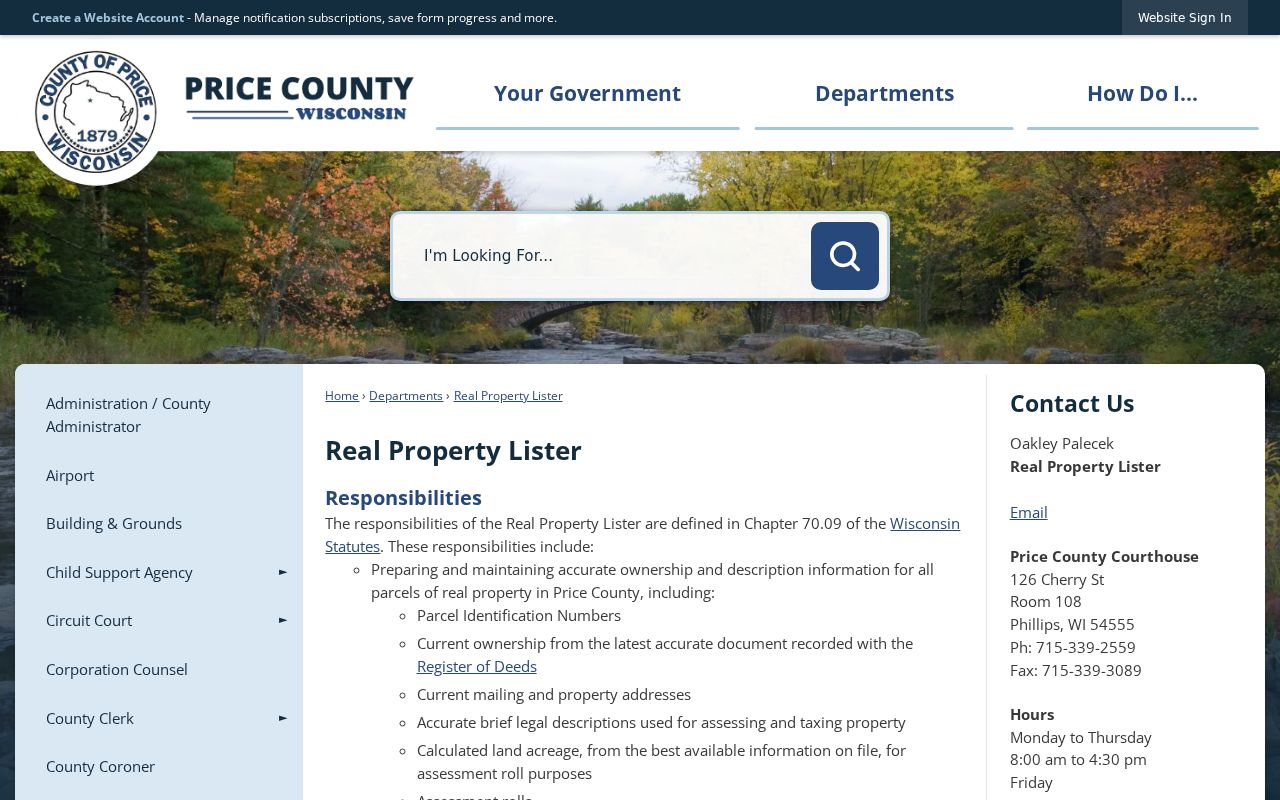
These fields place the owner name in its parcel context. The deed remains the recorded evidence of a transfer. Price County publishes no standard number of days. There is no fixed wait between recording and an owner-field change. A new instrument can easily outrun the last visible account update. Note the instrument's recording date. Note the tax year on any printed bill. Then contact the Lister if the parcel account has not caught up. Never treat the Treasurer's nightly refresh as a promise about title.
Price County Situs and Mailing Fields Are Separate
Price County tracks two addresses on every account. The situs tells you where the parcel actually sits. The mailing address is different; it tells the county where to send the tax bill. Those two can land in different cities or ZIP codes. One ZIP may even cross municipal lines. That is normal. To confirm which parcel is which, rely on the PIN and the mapped parcel rather than a city name. Jurisdiction follows the land, not the mailbox. A mailing address never proves that anyone occupies the property.
A notice sometimes lands at a stale or incomplete mailing address. Take the account record to the Real Property Lister. Maintaining addresses and ownership is part of that office's listed duties. Ask the office directly about any recent change. An online tax bill alone can't confirm the correspondence field is current.
Comparing accounts? Sort by PIN first, mailing city second. Two Price County parcels can share one mailing address. A rural parcel often carries a postal city from a different municipality than the one holding the land. Keep in mind that the situs describes location only. It says nothing about who lives there. Fixing the mailing address, on its own, changes neither the owner of record nor the parcel's legal description on the deed records.
Price County Current Owner Names Can Include a Trust or LLC
The owner field sometimes names a company or trust. It may not name the person who actually controls the parcel. Read the deed's grantee line exactly as filed. Note whether the named party is a trustee, a company, or an estate. Wisconsin DFI's corporate search can add public context about the entity. Its registered agent is not automatically the owner of record, though. Before drawing any conclusion, tie the corporate filing back to the parcel's deed. For a court-managed transfer, WCCA can help locate a circuit-court case summary. Public terminals are also available at the courthouse. Those court records may explain a representative's role. Still, the current owner question turns on the latest recorded conveyance. And it turns on the Lister's parcel entry.
When an entity shows up, preserve the exact grantee wording. That includes any trustee capacity or company suffix, before searching Wisconsin DFI. The business filing can identify an organization or its registered agent. Price County's recorded instrument is what links the entity name to the described parcel. A corporate result without the matching PIN or land description is only background.
Price County Current Owner Searches Should Not Treat 271- as a PIN
A Park Falls permit application includes a legacy parcel number that begins with 271-. The same form collects the owner name, work site, applicant, estimated cost, and start date. That legacy field serves a city building-permit purpose. It is not a universal county PIN. A city clerk can use it to connect a permit to a parcel. It does not replace the Lister owner field. Nor does it replace the deed reference. Other Price County municipalities run their own forms and records channels. Phillips publishes forms and zoning materials. Prentice posts permit forms and a zoning code. Across all those places, the county-held record remains the source for the current owner.
On the Park Falls application, the legacy number sits beside the work-site address. Owner, applicant, estimated cost, and start date sit there. Staff can use it to link a building project to its local file. It is not the county identifier used across the land and tax systems. Keep the permit number and the county PIN separate. Use both keys when comparing a proposed improvement with the parcel account.
Price County Current Owner Alerts Flag a Filing Name Match
The Register of Deeds offers a no-cost name-match notification service for recorded documents. It is a useful monitoring tool. Identical names can still create a false lead, however. A match does not block a filing or prove fraud. Read the instrument itself. Confirm the legal description. Then contact the office if the filing appears to concern your parcel. The county's notice about deed-copy solicitations is a separate consumer warning. It is not a record of ownership.
Confirming a Current Owner in Price County
Use the county tax roll for the current account name and the Register of Deeds for the recorded conveyance. Both records must match the same PIN or legal description. If a sale is recent, the instrument may be newer than the tax publication, whose stated nightly refresh does not define deed processing time.
- Read the owner name and PIN maintained by the Real Property Lister.
- Find the newest deed and verify its parties and legal description.
- Compare the recording date with the tax record’s own year or update information.
- Ask the custodian about a mismatch or an unavailable instrument.
- Owner of record
- The name maintained in the county parcel account.
- Grantee
- The party named as receiving an interest in the deed.
- Situs and mailing
- Land location and tax correspondence address, respectively.
Price County's chain of confirmation is a comparison of records, not a single lookup. The Lister supplies the present account name. The Register of Deeds supplies the recorded instrument. The Treasurer provides a separate tax view. If the names differ, record which source and date each came from, then ask the responsible office whether a later document or account correction is pending. That preserves the distinction between a filed transfer and a published account field.
Using Price County’s Current Owner Mailing Field
The Lister mailing address is a public-record correspondence field, separate from the parcel's situs. Use it only for a legitimate property matter. Respect confidentiality programs and legal protections. Wisconsin Safe at Home participants may have substitute addresses and public-record shielding. Check current rules and agency steps with the DOJ.
Lawful use. Owner information is for property research and related due diligence. Never use a Price County owner record to stalk, threaten, harass or harm a person.